


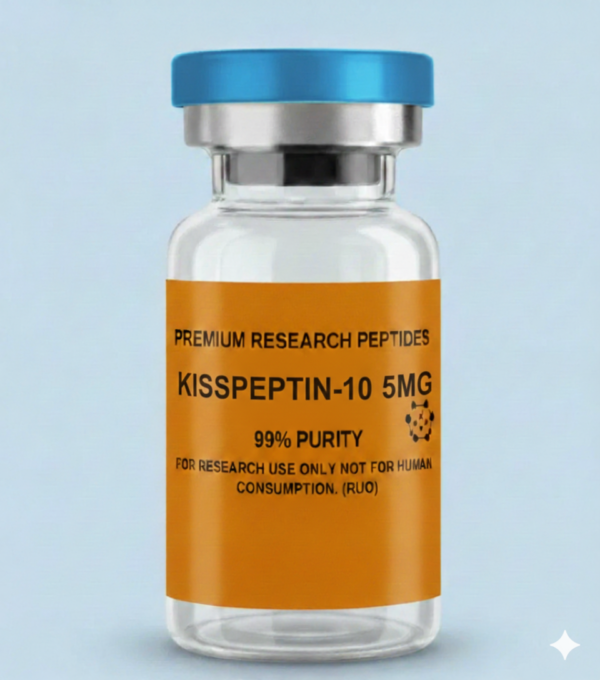
Kisspeptin-10 5mg – ≥99% Purity Research Peptide
What is Kisspeptin-10?
Kisspeptin-10, also known as metastin(45-54), is a potent neuropeptide derived from the KISS1 gene. It acts as a key regulator in the hypothalamic-pituitary-gonadal (HPG) axis, stimulating the release of luteinizing hormone (LH) and follicle-stimulating hormone (FSH).
Researchers worldwide use Kisspeptin-10 in vitro to study puberty onset, fertility regulation, and hormonal feedback mechanisms.
Our Kisspeptin-10 is synthesized via state-of-the-art solid-phase peptide synthesis (SPPS), guaranteeing exceptional sequence fidelity and bioactivity.
Key Benefits for Research
- High Purity: ≥99% purity confirmed by HPLC and mass spectrometry
- Precise Dosing: 5 mg lyophilized powder per vial for easy reconstitution
- Excellent Stability: Long-term storage at -20°C with minimal degradation
- Versatile Use: Suitable for cell culture, receptor binding assays, and animal models
Product Specifications
- Molecular Formula: C63H83N17O14
- Molecular Weight: 1302.45 g/mol
- Sequence: Tyr-Asn-Trp-Asn-Ser-Phe-Gly-Leu-Arg-Phe-NH2 (YNWNSFGLRF-NH2)
- CAS Number: 374675-16-8
- PubChem CID: 71306348
- Appearance: White lyophilized powder
- Solubility: Soluble in water or saline
Packaging & Storage
Each vial contains 5 mg of Kisspeptin-10, aseptically filled and lyophilized. Store desiccated at -20°C. Avoid repeated freeze-thaw cycles.
Research Applications of Kisspeptin-10
In preclinical studies, Kisspeptin-10 has been widely used for:
- Investigating KISS1R/GPR54 signaling pathways
- Modeling hypogonadotropic hypogonadism and infertility
- Studying negative and positive sex-steroid feedback in the hypothalamus
- Exploring links between reproduction and metabolism/appetite regulation
Order Kisspeptin-10 5mg today from Peptide Basics — trusted by researchers for quality and consistency.
Frequently Asked Questions
How does Kisspeptin-10 differ from longer kisspeptin fragments (KP-54, KP-14, etc.)?
Kisspeptin-10 is the C-terminal decapeptide and represents the minimal sequence required for full agonist activity at the kisspeptin receptor (KISS1R/GPR54). It offers equivalent potency to longer fragments but with lower molecular complexity, making it preferred for many receptor and signaling studies.