

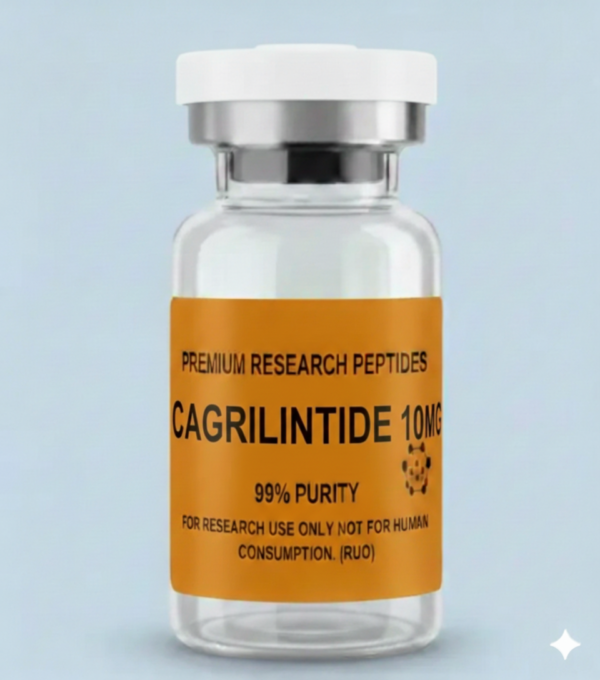
Buy Cagrilintide 10mg – 99.9% Pure Research Peptide (Third-Party Tested)
What is Cagrilintide?
Cagrilintide (developmental code NN9833) is a synthetic, non-glycosylated, 37-amino-acid peptide engineered by Novo Nordisk as a second-generation amylin mimetic. It exhibits significantly prolonged plasma half-life compared to native amylin or pramlintide due to C-terminal amidation and strategic amino acid substitutions that improve stability and receptor affinity.
In preclinical and phase II/III clinical trials, cagrilintide has demonstrated remarkable synergistic effects when co-administered with GLP-1 receptor agonists such as semaglutide (e.g., CagriSema), producing up to 20–25% sustained body weight reduction in obese subjects — far exceeding results from either compound alone.
Cagrilintide Peptide Sequence
KCNTATCATQRLANFLVHSSNNFGPILPPTNVGSNTY-(NH₂)
(Disulfide bridge: Cys2–Cys7)
Key Specifications – Cagrilintide 10mg
- CAS Number: 1336230-95-6 (free base)
- Molecular Formula: C₂₀₉H₃₀₃N₅₁O₆₄S₂
- Molecular Weight: 4619.24 g/mol
- Purity: ≥99.9% (HPLC, third-party tested)
- Appearance: White to off-white lyophilized powder
- Solubility: Soluble in water and acetic acid; recommended reconstitution with bacteriostatic water
- Form: Lyophilized from acetonitrile/water with TFA salt
- Storage: Long-term −20°C or −80°C (desiccated & protected from light); reconstituted solution stable 30 days at 4°C
Primary Research Applications of Cagrilintide
- Appetite regulation and satiety signaling via area postrema activation
- Long-term body weight management studies in diet-induced obesity (DIO) models
- Synergistic combination research with GLP-1 agonists (semaglutide, liraglutide, tirzepatide)
- Investigation of adipose tissue browning and energy expenditure
- Insulin sensitivity, glucose homeostasis, and type 2 diabetes modeling
- Neuroendocrine effects on food preference and reward pathways
Pharmacokinetics & Half-Life
Cagrilintide has a terminal elimination(“,”,”) half-life of approximately 180–200 hours in humans following subcutaneous administration, enabling true once-weekly dosing — a major improvement over pramlintide (half-life ~40 minutes).
Reconstitution & Handling Guidelines
- Slowly add desired volume of bacteriostatic water or 0.1% acetic acid along vial wall
- Gently swirl — do NOT shake vigorously
- Typical concentration: 2–5 mg/mL
- Aliquot and store at 4°C for short-term or −80°C for long-term storage
Comparison: Cagrilintide vs Pramlintide vs Native Amylin
| Property | Native Amylin | Pramlintide | Cagrilintide |
|---|---|---|---|
| Half-life | ~13 min | ~40 min | ~180–200 h |
| Dosing frequency | Multiple daily | Pre-meal TID | Once weekly |
| Weight loss (monotherapy) | Minimal | ~1–3 kg | ~8–15% (phase II) |
| Synergy with GLP-1 RA | Limited data | Moderate | Very strong (CagriSema) |
Why Researchers Choose Peptide Basics for Cagrilintide 10mg
-
- ≥99.9% purity confirmed by independent U.S. and EU labs
- Full CoA, HPLC, and mass spectrometry data included with every order