
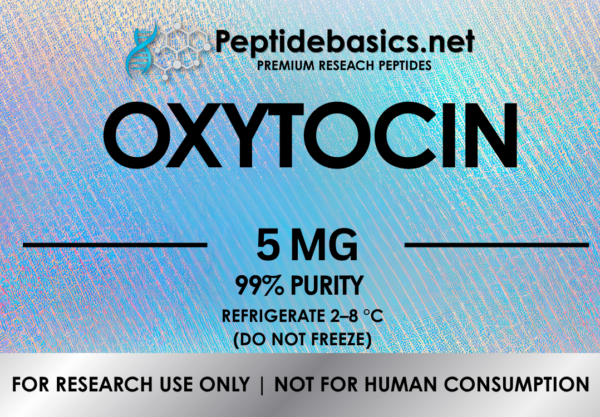
Oxytocin Acetate is the acetate salt form of oxytocin, a naturally occurring cyclic nonapeptide hormone and neurotransmitter (sequence: Cys-Tyr-Ile-Gln-Asn-Cys-Pro-Leu-Gly-NH₂, with a disulfide bridge). It is commonly supplied as a high-purity (typically ≥98%) lyophilized powder or crystalline solid for laboratory research.1
Chemical Properties
Molecular formula (free base): C₄₃H₆₆N₁₂O₁₂S₂ (MW ≈ 1007.2 Da); acetate salt form is approximately C₄₅H₇₀N₁₂O₁₄S₂ (MW ≈ 1067.2–1067.25 Da).2
CAS numbers: 50-56-6 (oxytocin base) or 6233-83-6 (acetate salt).
It is soluble in water, PBS, DMSO, and other polar solvents, making it suitable for preparing solutions for in vitro or in vivo (animal) studies.
Research Uses
In laboratory and clinical research settings, Oxytocin Acetate is studied for its roles in:
Social cognition, trust, empathy, and behaviors (often via intranasal administration in human trials).
Reproductive physiology (uterine contraction, milk ejection).
Potential effects on anxiety, autism spectrum disorder, PTSD, schizophrenia, pain modulation, appetite regulation, obesity, and metabolic function.
Animal models for behavioral, neurological, or physiological studies.3
It is strictly for research use only (RUO) or in vitro / laboratory experimentation. Suppliers explicitly state it is not for human or veterinary diagnostic or therapeutic use.