Adamax 5mg – Enhanced Semax Analog Research Peptide Vial | 99%+ Purity
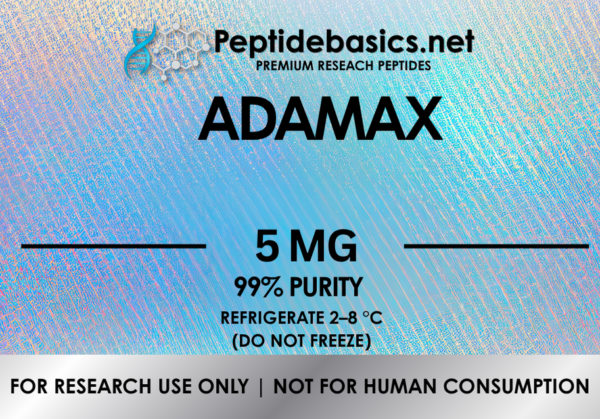
Price: $32.00 USD | SKU: ADAMAX-5MG | Purity: 99%+ (HPLC) | Form: 5mg Lyophilized Vial
This product is strictly FOR RESEARCH PURPOSES ONLY. Not for human consumption, human use, veterinary use, diagnosis, or treatment. Not FDA-approved. Misbranding or misuse is prohibited by law. Intended solely for qualified laboratory professionals conducting in vitro or animal research. By purchasing, you confirm you are a researcher and agree to all terms.
What is Adamax Peptide?
Adamax is a synthetic, advanced analog of Semax, modified with an adamantane group (and often N-acetyl protection in related structures) to enhance its chemical stability, lipophilicity, and ability to cross the blood-brain barrier (BBB) in experimental models. Drawing from research on neurotrophic peptides and structures like those inspired by P21 or N-acetyl Semax amidate, Adamax is engineered as a next-generation research compound in the nootropic and neuroprotective peptide family.
Originally derived from the ACTH(4-10) fragment (like Semax), Adamax incorporates modifications that researchers investigate for improved pharmacokinetic properties—greater resistance to enzymatic degradation and prolonged activity—making it a subject of interest in studies on neuronal signaling, plasticity, and resilience pathways.
Key Research Areas and Mechanisms of Adamax
Adamax is primarily studied in preclinical models for its potential influence on neurotrophic and neuroprotective pathways. Researchers explore the following areas (note: these are investigational observations from in vitro, animal, or mechanistic studies; no human efficacy is implied):
- BDNF & TrkB Signaling: Investigated for upregulation of brain-derived neurotrophic factor (BDNF) expression and enhanced sensitivity of hippocampal TrkB receptors, which play roles in synaptic plasticity, neuronal survival, and adaptation in stress or injury models.
- Neuroprotection: Examined in contexts of oxidative stress, ischemia, or neuroinflammation for potential support of neuronal resilience and mitochondrial stability.
- Cognitive & Nootropic Pathways: Studied in experimental settings related to attention, memory formation, learning, and mental processing through modulation of neurotransmitter systems and neuroplasticity.
- Endurance & Recovery Research: Associated in some models with faster recovery dynamics and performance under exertion-like conditions, potentially linked to neurotrophic support.
These mechanisms stem from broader research on Semax-family peptides, where Adamax’s modifications are hypothesized to amplify or extend such effects in lab environments.
Adamax vs Semax: Key Differences in Research Contexts
Adamax is frequently positioned as an upgraded analog of Semax in vendor and technical discussions. Here’s a comparison based on reported structural and mechanistic distinctions:
| Feature | Semax | Adamax |
|---|---|---|
| Structure | ACTH(4-10) analog: Met-Glu-His-Phe-Pro-Gly-Pro | Adamantane-modified Semax analog (often with N-acetyl/ amidate elements) |
| Stability & BBB Penetration | Moderate enzymatic resistance and BBB crossing | Enhanced lipophilicity and stability due to adamantane group; researched for superior BBB penetration and longer half-life |
| Potency in Models | Well-studied for BDNF/TrkB, neuroprotection, cognition | Often described as 2–3x more potent or prolonged in preclinical cognitive/endurance outcomes (vendor/research discussions) |
| Primary Research Focus | Neuroplasticity, stress response, memory | Amplified neurogenesis support, neuroprotection, extended neurotrophic effects |
While Semax has more established research literature (e.g., studies on BDNF regulation and stroke models), Adamax is explored as a more bioavailable variant for advanced applications.
Product Specifications & Purity
- Quantity: 5mg per vial
- Purity: 99%+ verified by High-Performance Liquid Chromatography (HPLC)
- Form: Lyophilized (freeze-dried) white powder
- Testing: Third-party Certificates of Analysis (COAs) available upon request for batch verification
- Packaging: Vacuum-sealed sterile vial for optimal stability
Lab Usage: Reconstitution & Storage Guidelines
For research purposes only:
- Reconstitution: Use bacteriostatic water or sterile saline. Typical: Add 1–2 mL to achieve desired concentration (e.g., 2.5 mg/mL with 2 mL). Gently swirl—do not shake vigorously to avoid degradation.
- Storage: Lyophilized: Store at -20°C or below for long-term. Reconstituted: Refrigerate at 2–8°C; use within 2–4 weeks. Protect from light and freeze-thaw cycles.
- Handling: Use sterile techniques in a controlled lab environment.
Frequently Asked Questions (FAQs) about Adamax Research Peptide
- What is Adamax compared to Semax?
- Adamax is an adamantane-modified analog of Semax, researched for improved stability, lipophilicity, and BBB penetration, potentially offering enhanced effects in neurotrophic studies.
- Is Adamax for human use?
- No. Strictly Research Use Only (RUO). Not approved for human consumption, veterinary use, or any therapeutic application.
- What purity is this Adamax?
- 99%+ purity confirmed via HPLC, with third-party testing available.
- How should Adamax be stored for research?
- Lyophilized form: -20°C or colder. Reconstituted: 2–8°C refrigerator, short-term use.
Explore Related Research Compounds
- Semax 10mg Research Peptide
- Selank Peptide
- All Nootropic & Neuroprotective Peptides
- Ultimate Nootropic Peptides Research Guide
THIS PRODUCT IS FOR LABORATORY RESEARCH PURPOSES ONLY (RUO). NOT FOR HUMAN OR VETERINARY USE. NOT INTENDED TO DIAGNOSE, TREAT, CURE, OR PREVENT ANY DISEASE. PEPTIDE BASICS ASSUMES NO LIABILITY FOR MISUSE. © 2026 Peptide Basics. All rights reserved.