
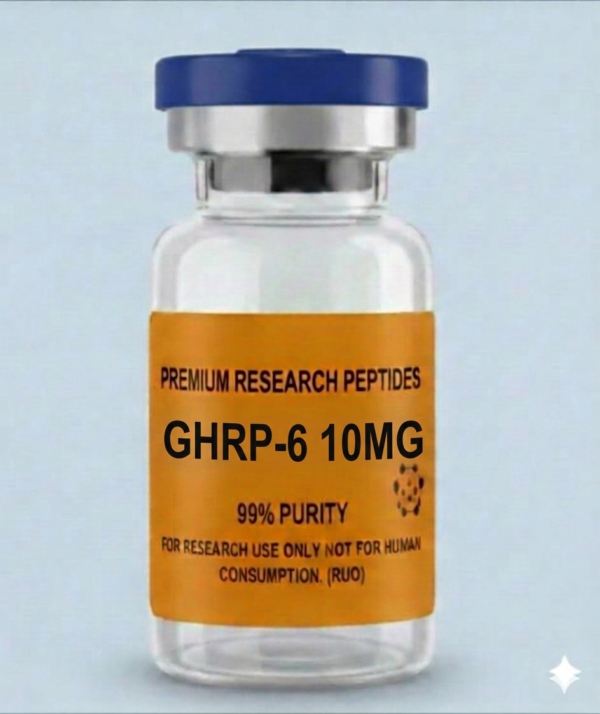
GHRP-6 (Growth Hormone-Releasing Peptide-6), also known as growth hormone-releasing hexapeptide, is a synthetic hexapeptide with the sequence His-D-Trp-Ala-Trp-D-Phe-Lys-NH₂. It acts as a growth hormone secretagogue (GHS), mimicking the action of ghrelin (the “hunger hormone”) by binding primarily to the ghrelin receptor (GHSR-1a, formerly called the growth hormone secretagogue receptor).
Unlike Growth Hormone-Releasing Hormone (GHRH), GHRP-6 has no structural similarity to it and works through a different pathway, often synergizing with GHRH analogs for amplified effects. It stimulates pulsatile release of growth hormone (GH) from the pituitary gland’s somatotroph cells without disrupting normal feedback mechanisms involving somatostatin or IGF-1.
How GHRP-6 Works
- It activates the ghrelin receptor in the hypothalamus and pituitary.
- This leads to increased GH secretion (dose-dependent).
- It also binds to the CD36 receptor, which may contribute to anti-inflammatory, antioxidant, and cell-protective effects observed in some preclinical studies.
- A notable effect is strong stimulation of appetite via ghrelin pathways, which is more pronounced than with many other GHRPs.
It is typically administered via subcutaneous injection (as it is a peptide), though early research noted some oral activity in certain models. Half-life is relatively short (~2-3 hours or less), so multiple daily doses are common in research settings.
Common Reported Benefits (Primarily from Preclinical and Limited Human Studies)
- Increased GH and IGF-1 levels — Supporting muscle growth, recovery, and body composition improvements.
- Appetite stimulation — Often called the “hunger hormone from hell” in bodybuilding contexts; useful for bulking or hardgainers needing higher calorie intake.
- Potential improvements in recovery, strength, lean mass, fat metabolism, sleep, and wound healing (via GH effects and possible direct tissue protection).
- Cardioprotective and anti-fibrotic potential — Some animal studies suggest it may reduce oxidative stress, preserve mitochondrial function, and attenuate damage in models of ischemia/reperfusion, doxorubicin toxicity, or multi-organ failure.
- Other exploratory effects include possible benefits for glucose metabolism, memory, and anti-catabolic actions in research models.