

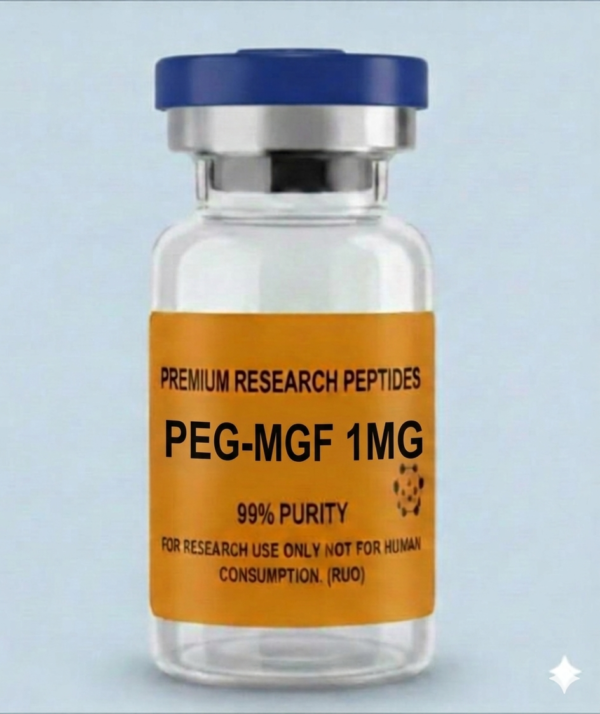
PEG-MGF (Pegylated Mechano Growth Factor) is a synthetic peptide that’s popular in bodybuilding, athletic recovery, and research contexts for its role in muscle repair and growth.
It’s a modified version of Mechano Growth Factor (MGF), which is a splice variant (isoform) of IGF-1 (Insulin-like Growth Factor-1), specifically IGF-1Ec. Your body naturally produces MGF in response to mechanical stress on muscles—like from heavy lifting, injury, or intense training—to help activate satellite cells (muscle stem cells), promote their proliferation and fusion into muscle fibers, and support localized repair and hypertrophy.
Why “PEG”?
Plain MGF has a very short half-life (just 5–7 minutes), so it’s quickly broken down. Pegylation attaches a polyethylene glycol (PEG) chain to the molecule, dramatically extending its half-life to around 48–72 hours. This makes it more stable, allows it to circulate longer in the bloodstream, and improves its overall effectiveness for systemic or targeted muscle recovery.
Main Claimed Benefits (Based on Research & User Reports)
- Accelerates muscle recovery and repair after workouts or injury.
- Promotes muscle growth (hypertrophy) by increasing satellite cell activity and new nuclei in muscle fibers.
- May support tissue repair in muscles, tendons, bones, and even neural/cardiac tissue.
- Some studies/anecdotal reports note improved nitrogen retention, protein synthesis, reduced body fat potential, and faster healing.
It’s often used by athletes or in peptide therapy clinics for recovery optimization, sometimes stacked with other compounds like IGF-1 LR3, BPC-157, or growth hormone-related peptides.